Midwifery Today Articles

= Membership Article.

To browse by issue, click here

Chios Island Hospital, Greece

Midwifery in a Refugee Camp

It’s 6 o’clock in the morning. Inigo, our Spanish physician, receives an early phone call from the camp police. They think a woman is in labor. He wakes me up. Our volunteer’s small house is very quiet. Everyone’s asleep and I quickly get dressed, putting on a sweater over my pajamas, pants, scarf, coat, and gloves. We’re taking off to the camp. The roads are empty, it’s dark, and we’re making the trip to the camp in half the time.

This post is only available to members. To purchase an online membership, go here.

If you are already an online member login here.

 Read more…. Midwifery in a Refugee Camp

Village Midwife: Where Has All the Wisdom Gone?

I trotted toward the little Mexican village of Salitrillo, trying to keep up with Doña Juanita who was two decades my senior. We were going to make four prenatal home visits where I would observe Doña Juanita offering the Mexican sobada (massage) and rebozo (sacred cloth). All the Mexican traditional midwives used these skills as part of their regular prenatal care. Although I had observed for nearly a decade, I still marveled at what wisdom and art lay in the assessment and application of these simple hands-on tools—oil and cloth. Read more…. Village Midwife: Where Has All the Wisdom Gone?

A Mother and Daughter, Serving Mothers and Babies The Story of a Mother-Daughter Team of Placenta Encapsulators

Not many mothers and daughters have the privilege of sharing a work life in addition to a family life. When they do, it’s not usually in such a unique professional niche as placenta encapsulation. For the past five years, my mom, Ruth Ripple, and I have worked together as a mother-daughter team, providing placenta encapsulation services in western Colorado. It’s a deeply beautiful feeling, using our mother-daughter relationship to support other women’s journeys into motherhood.

This post is only available to members. To purchase an online membership, go here.

If you are already an online member login here.

 Read more…. A Mother and Daughter, Serving Mothers and Babies The Story of a Mother-Daughter Team of Placenta Encapsulators

Scribonia Attica: A Second-century Roman Midwife

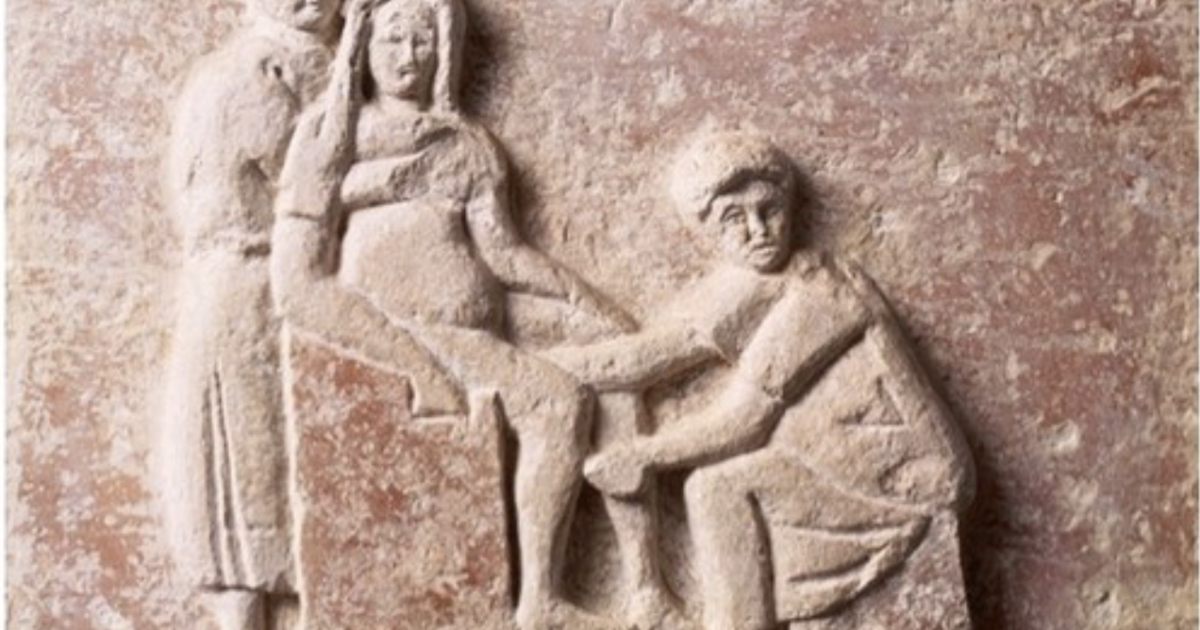
Midwifery Today, Issue 133, Spring 2020. Join Midwifery Today Online Membership Sometimes the history of midwifery is hidden in a tomb. This statement is not a metaphor for lost history; it’s reality. In the Isola Sacra necropolis in Ostia, a seaport of ancient Rome (originally situated at the mouth of the Tiber River but today located about four miles upstream) in Italy, lies the tomb of Scribonia Attica, a second-century Roman midwife. Her funeral monument is striking because it depicts the midwife herself, squatting on a low stool in front of a naked pregnant woman who is seated in a chair and supported by another woman from behind. The midwife looks out directly at the viewer of her memorial, while her right hand reaches between the laboring woman’s legs, perhaps to check the woman’s progress or to deliver her baby. The name of this midwife, Scribonia Attica, reveals a little bit about her. She shared her first name with the Scribonia family of ancient Rome as well as two famous women: the wife of Octavian, later the Emperor Augustus, who ruled during the first century CE (when Jesus was born); and the wife of Crassus, who was a first century CE Roman man of consular rank. The midwife’s first name was also the first name of her mother, Scribonia Callityche. The midwife’s surname, Attica, suggests that she was of Greek origin (Totelin 2019). Scribonia’s Greek origins are worth considering. The Roman Empire conquered the Greek Empire militarily (ca. 328–168 BCE), but in a sense, the Greeks subsequently conquered the Roman Empire culturally. Greek culture influenced Roman culture in terms of language, philosophy, religion, art, architecture, and medicine, among other things. Indeed, it appears that early first millennium, upper-class Roman families were often attended in childbirth by Greek midwives. Many ancient… Read more…. Scribonia Attica: A Second-century Roman Midwife

This post is only available to members. To purchase an online membership, go here.

If you are already an online member login here.

 Read more…. Scribonia Attica: A Second-century Roman Midwife

Marion’s Message: The First-time Women’s Health Exam

Midwives serve women in a variety of ways. Midwife Marion McLean shares how she works with women in their first-time health exams.

This post is only available to members. To purchase an online membership, go here.

If you are already an online member login here.

 Read more…. Marion’s Message: The First-time Women’s Health Exam

The Third Stage of Labor

The third stage of labor is the period following expulsion of the baby (second stage) via the birth canal. It usually takes approximately 5–30 minutes until the placenta and membranes are expelled. After this, lochia and lactation commence.

This post is only available to members. To purchase an online membership, go here.

If you are already an online member login here.

 Read more…. The Third Stage of Labor

The Future of Lullabies

This is an obligatory topic for students of human nature who understand Homo as a primate endowed of the capacity to develop sophisticated ways to communicate.… Read more…. The Future of Lullabies

Rose and Saffira’s Birth

Birth is not solely the journey of the physical body, of a baby and a mother, but rather an entire constellation changing shape as a new soul emerges from water to land. The process of birth encompasses the whole universe and mystery of life—it means surrendering everything that one knows, accepting what reveals itself in the moment, and merging into the unbounded life beyond body and mind.

This post is only available to members. To purchase an online membership, go here.

If you are already an online member login here.

 Read more…. Rose and Saffira’s Birth

Saving Women’s Lives in Uganda

The death of childbearing women is a challenge to health workers worldwide. Why are pregnant and postpartum women so vulnerable to death?

This post is only available to members. To purchase an online membership, go here.

If you are already an online member login here.

 Read more…. Saving Women’s Lives in Uganda

Do We Need Midwives?

This question was the title of a book intended for the British public (Odent 2017). In the United Kingdom, everybody is familiar with the term midwife. Traditionally, midwives were considered vital and respectable persons. There is even a Royal College of Midwives.

This post is only available to members. To purchase an online membership, go here.

If you are already an online member login here.

 Read more…. Do We Need Midwives?

Becoming

Poem by Kristin Keith | Issue 132

This post is only available to members. To purchase an online membership, go here.

If you are already an online member login here.

 Read more…. Becoming

Skip to content